
HIST 394: World Economies
Research guide to accompany HIST 394: World Economies.
Industrial Segregation
-
 Industrial Segregation
by
Call Number: MAC New Titles - Main Level E185.8 .G798 2018Publication Date: 2018
Industrial Segregation
by
Call Number: MAC New Titles - Main Level E185.8 .G798 2018Publication Date: 2018

Books
-
 Environmental Activism and the Urban Crisis: Baltimore, St. Louis, Chicago
by
Environmental Activism and the Urban Crisis focuses on the wave of environmental activism and grassroots movements that swept through America's older, industrial cities during the late 1960s and early 1970s. Robert Gioielli offers incisive case studies of Baltimore, St. Louis, and Chicago to show how urban activism developed as an impassioned response to a host of racial, social, and political conflicts. As deindustrialization, urban renewal, and suburbanization caused the decline of the urban environment, residents--primarily African Americans and working-class whites--organized to protect their families and communities from health threats and environmental destruction.
Call Number: eBookPublication Date: 2014
Environmental Activism and the Urban Crisis: Baltimore, St. Louis, Chicago
by
Environmental Activism and the Urban Crisis focuses on the wave of environmental activism and grassroots movements that swept through America's older, industrial cities during the late 1960s and early 1970s. Robert Gioielli offers incisive case studies of Baltimore, St. Louis, and Chicago to show how urban activism developed as an impassioned response to a host of racial, social, and political conflicts. As deindustrialization, urban renewal, and suburbanization caused the decline of the urban environment, residents--primarily African Americans and working-class whites--organized to protect their families and communities from health threats and environmental destruction.
Call Number: eBookPublication Date: 2014 -
 From Bondage to Contract
by
This book explores how a generation of American thinkers and reformers - abolitionists, former slaves, feminists, labor advocates, jurists, moralists, and social scientists - drew on contract to condemn the evils of chattel slavery as well as to measure the virtues of free society. Their arguments over the meaning of slavery and freedom were grounded in changing circumstances of labor and home life on both sides of the Mason-Dixon line. At the heart of these arguments lay the problem of defining which realms of self and social existence could be rendered market commodities and which could not. From Bondage to Contract reveals how the problem of distinguishing between what was saleable and what was not reflected the ideological and social changes wrought by the concurrence of abolition in the South and burgeoning industrial capitalism in the North."
Call Number: eBookPublication Date: 1998
From Bondage to Contract
by
This book explores how a generation of American thinkers and reformers - abolitionists, former slaves, feminists, labor advocates, jurists, moralists, and social scientists - drew on contract to condemn the evils of chattel slavery as well as to measure the virtues of free society. Their arguments over the meaning of slavery and freedom were grounded in changing circumstances of labor and home life on both sides of the Mason-Dixon line. At the heart of these arguments lay the problem of defining which realms of self and social existence could be rendered market commodities and which could not. From Bondage to Contract reveals how the problem of distinguishing between what was saleable and what was not reflected the ideological and social changes wrought by the concurrence of abolition in the South and burgeoning industrial capitalism in the North."
Call Number: eBookPublication Date: 1998 -
 Garbage Wars (Urban and Industrial Environments): The Struggle for Environmental Justice in Chicago
by
A study of the struggle for environmental justice, focusing on conflicts over solid waste and pollution in Chicago.In Garbage Wars, the sociologist David Pellow describes the politics of garbage in Chicago. He shows how garbage affects residents in vulnerable communities and poses health risks to those who dispose of it. He follows the trash, the pollution, the hazards, and the people who encountered them in the period 1880-2000. What unfolds is a tug of war among social movements, government, and industry over how we manage our waste, who benefits, and who pays the costs.Studies demonstrate that minority and low-income communities bear a disproportionate burden of environmental hazards. Pellow analyzes how and why environmental inequalities are created. He also explains how class and racial politics have influenced the waste industry throughout the history of Chicago and the United States.
Call Number: eBookPublication Date: 2002
Garbage Wars (Urban and Industrial Environments): The Struggle for Environmental Justice in Chicago
by
A study of the struggle for environmental justice, focusing on conflicts over solid waste and pollution in Chicago.In Garbage Wars, the sociologist David Pellow describes the politics of garbage in Chicago. He shows how garbage affects residents in vulnerable communities and poses health risks to those who dispose of it. He follows the trash, the pollution, the hazards, and the people who encountered them in the period 1880-2000. What unfolds is a tug of war among social movements, government, and industry over how we manage our waste, who benefits, and who pays the costs.Studies demonstrate that minority and low-income communities bear a disproportionate burden of environmental hazards. Pellow analyzes how and why environmental inequalities are created. He also explains how class and racial politics have influenced the waste industry throughout the history of Chicago and the United States.
Call Number: eBookPublication Date: 2002 -
 Going down Jericho Road
by
Memphis in 1968 was ruled by a paternalistic "plantation mentality" embodied in its good-old-boy mayor, Henry Loeb. Wretched conditions, abusive white supervisors, poor education, and low wages locked most black workers into poverty. Then two sanitation workers, seeking shelter from one of the city's notorious torrential rains, were chewed up like refuse in the back of a faulty truck, igniting a months-long public-employee strike that would shake the nation.""With novelistic drama and rich scholarly detail, Michael Honey brings to life the magnetic characters who clashed on the Memphis battlefield: the resolute black workers; strike leaders like the impoverished, driven T.O. Jones; black ministers like Martin Luther King's longtime ally, the inspired and dedicated Reverend James Lawson, and his flamboyant colleague, Reverend Ralph Jackson; union men; the first black members of the Memphis city council; dynamic black women like civil rights leader Maxine Smith and community advocate Cornella Crenshaw; and volatile young Black Power advocates like Coby Smith and Charles Cabbage."
Call Number: eBookPublication Date: 2007
Going down Jericho Road
by
Memphis in 1968 was ruled by a paternalistic "plantation mentality" embodied in its good-old-boy mayor, Henry Loeb. Wretched conditions, abusive white supervisors, poor education, and low wages locked most black workers into poverty. Then two sanitation workers, seeking shelter from one of the city's notorious torrential rains, were chewed up like refuse in the back of a faulty truck, igniting a months-long public-employee strike that would shake the nation.""With novelistic drama and rich scholarly detail, Michael Honey brings to life the magnetic characters who clashed on the Memphis battlefield: the resolute black workers; strike leaders like the impoverished, driven T.O. Jones; black ministers like Martin Luther King's longtime ally, the inspired and dedicated Reverend James Lawson, and his flamboyant colleague, Reverend Ralph Jackson; union men; the first black members of the Memphis city council; dynamic black women like civil rights leader Maxine Smith and community advocate Cornella Crenshaw; and volatile young Black Power advocates like Coby Smith and Charles Cabbage."
Call Number: eBookPublication Date: 2007 -
 Political Economy of the Black Ghetto
by
Professor Tabb analyses the manner in which vested interests use economic power to resist ghetto reform and sets forth new proposals to do away with the restriction that hedge in ghetto occupants and prevent them from achieving a fair share of American prosperity.
Call Number: eBookPublication Date: 1970
Political Economy of the Black Ghetto
by
Professor Tabb analyses the manner in which vested interests use economic power to resist ghetto reform and sets forth new proposals to do away with the restriction that hedge in ghetto occupants and prevent them from achieving a fair share of American prosperity.
Call Number: eBookPublication Date: 1970 -
 Reconstruction: America's Unfinished Revolution, 1863-1877
by
Chronicles how Americans responded to the changes unleashed by the Civil War and the end of slavery.
Call Number: eBookPublication Date: 1988
Reconstruction: America's Unfinished Revolution, 1863-1877
by
Chronicles how Americans responded to the changes unleashed by the Civil War and the end of slavery.
Call Number: eBookPublication Date: 1988 -
 The Reconstruction Desegregation Debate: The Politics of Equality and the Rhetoric of Place, 1870–1875
by
Call Number: eBookPublication Date: 2002
The Reconstruction Desegregation Debate: The Politics of Equality and the Rhetoric of Place, 1870–1875
by
Call Number: eBookPublication Date: 2002 -
 The Reconstruction of American Liberalism, 1865-1914
by
Tracing the formation of liberal political ideology from the end of the Civil War to the early 20th century, Nancy Cohen offers an interpretation of the origins and character of modern American liberalism. She argues that these values and programmes were formulated in the Gilded Age.
Call Number: eBookPublication Date: 2002
The Reconstruction of American Liberalism, 1865-1914
by
Tracing the formation of liberal political ideology from the end of the Civil War to the early 20th century, Nancy Cohen offers an interpretation of the origins and character of modern American liberalism. She argues that these values and programmes were formulated in the Gilded Age.
Call Number: eBookPublication Date: 2002 -
 The Retreats of Reconstruction
by
This book examines how de facto segregation unfolded and operated at the New Jersey shore after the Civil War. Weaving together histories of race, leisure, and consumption, it argues that the politics of mass consumption contained early desegregation efforts and prolonged Jim Crow.
Call Number: eBookPublication Date: 2016
The Retreats of Reconstruction
by
This book examines how de facto segregation unfolded and operated at the New Jersey shore after the Civil War. Weaving together histories of race, leisure, and consumption, it argues that the politics of mass consumption contained early desegregation efforts and prolonged Jim Crow.
Call Number: eBookPublication Date: 2016 -
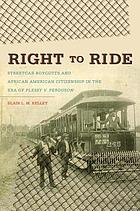 Right to Ride: Streetcar Boycotts and African American Citizenship in the Era of Plessy v. Ferguson
by
Focusing on three key cities--New Orleans, Richmond, and Savannah--Kelley explores African Americans' organized efforts to resist the passage of segregation laws dividing trains and streetcars by race in the early Jim Crow era. The book forces a reassessment of the timelines of the black freedom struggle, revealing that a period once dismissed as the age of accommodation should in fact be characterized as part of a history of protest and resistance.
Call Number: eBookPublication Date: 2010
Right to Ride: Streetcar Boycotts and African American Citizenship in the Era of Plessy v. Ferguson
by
Focusing on three key cities--New Orleans, Richmond, and Savannah--Kelley explores African Americans' organized efforts to resist the passage of segregation laws dividing trains and streetcars by race in the early Jim Crow era. The book forces a reassessment of the timelines of the black freedom struggle, revealing that a period once dismissed as the age of accommodation should in fact be characterized as part of a history of protest and resistance.
Call Number: eBookPublication Date: 2010 -
 Second Founding
by
The author retraces New York City's rich political heritage, arguing that the city's political and social structures resisted Reconstruction in the aftermath of the Civil War.
Call Number: eBookPublication Date: 2005
Second Founding
by
The author retraces New York City's rich political heritage, arguing that the city's political and social structures resisted Reconstruction in the aftermath of the Civil War.
Call Number: eBookPublication Date: 2005 -
 The Separate City
by
A ground-breaking collaborative study merging perspectives from history, political science, and urban planning, The Separate City is a trenchant analysis of the development of the African-American community in the urban South. While similar in some respects to the racially defined ghettos of the North, the districts in which southern blacks lived from the pre-World War II era to the mid-1960s differed markedly from those of their northern counterparts. The African- American community in the South was (and to some extent still is) a physically expansive, distinct, and socially heterogeneous zo.
Call Number: eBookPublication Date: 1995
The Separate City
by
A ground-breaking collaborative study merging perspectives from history, political science, and urban planning, The Separate City is a trenchant analysis of the development of the African-American community in the urban South. While similar in some respects to the racially defined ghettos of the North, the districts in which southern blacks lived from the pre-World War II era to the mid-1960s differed markedly from those of their northern counterparts. The African- American community in the South was (and to some extent still is) a physically expansive, distinct, and socially heterogeneous zo.
Call Number: eBookPublication Date: 1995 -
 Sweet Land of Liberty
by
Sweet Land of Liberty is an epic, revelatory account of the abiding quest for justice in states from Illinois to New York, and of how the intense northern struggle differed from and was inspired by the fight down South.
Call Number: eBookPublication Date: 2008
Sweet Land of Liberty
by
Sweet Land of Liberty is an epic, revelatory account of the abiding quest for justice in states from Illinois to New York, and of how the intense northern struggle differed from and was inspired by the fight down South.
Call Number: eBookPublication Date: 2008 -
 Between the World and Me
by
Ta-Nehisi Coates offers a framework for understanding our nation's history and current crisis. Americans have built an empire on the idea of "race," a falsehood that damages us all but falls most heavily on the bodies of black women and men -- bodies exploited through slavery and segregation, and, today, threatened, locked up, and murdered out of all proportion. What is it like to inhabit a black body and find a way to live within it? And how can we all honestly reckon with this fraught history and free ourselves from its burden? Between the World and Me is Coates's attempt to answer these questions in a letter to his adolescent son. Coates shares with his son -- and readers -- the story of his awakening to the truth about his place in the world through a series of revelatory experiences, from Howard University to Civil War battlefields, from the South Side of Chicago to Paris, from his childhood home to the living rooms of mothers whose children's lives were taken as American plunder
Call Number: MAC Service Desk - Reserves - 4 hour E185.615 .C6335 2015ISBN: 9780812993547Publication Date: 2015-07-14
Between the World and Me
by
Ta-Nehisi Coates offers a framework for understanding our nation's history and current crisis. Americans have built an empire on the idea of "race," a falsehood that damages us all but falls most heavily on the bodies of black women and men -- bodies exploited through slavery and segregation, and, today, threatened, locked up, and murdered out of all proportion. What is it like to inhabit a black body and find a way to live within it? And how can we all honestly reckon with this fraught history and free ourselves from its burden? Between the World and Me is Coates's attempt to answer these questions in a letter to his adolescent son. Coates shares with his son -- and readers -- the story of his awakening to the truth about his place in the world through a series of revelatory experiences, from Howard University to Civil War battlefields, from the South Side of Chicago to Paris, from his childhood home to the living rooms of mothers whose children's lives were taken as American plunder
Call Number: MAC Service Desk - Reserves - 4 hour E185.615 .C6335 2015ISBN: 9780812993547Publication Date: 2015-07-14 -
 Beyond the Ruins: The Meanings of Deindustrialization
by
Call Number: MAC Stacks - Level 4 HD5708.55.U6 B49 2003Publication Date: 2003
Beyond the Ruins: The Meanings of Deindustrialization
by
Call Number: MAC Stacks - Level 4 HD5708.55.U6 B49 2003Publication Date: 2003 -
 Buying Power: A History of Consumer Activism in America
by
A sweeping and definitive history of this political tradition, Buying Power traces its lineage back to our nation's founding, revealing that Americans used purchasing power to support causes and punish enemies long before the world boycott even entered our lexicon.
Call Number: MAC Stacks - Level 4 HC110.C6 G56 2009Publication Date: 2009
Buying Power: A History of Consumer Activism in America
by
A sweeping and definitive history of this political tradition, Buying Power traces its lineage back to our nation's founding, revealing that Americans used purchasing power to support causes and punish enemies long before the world boycott even entered our lexicon.
Call Number: MAC Stacks - Level 4 HC110.C6 G56 2009Publication Date: 2009 -
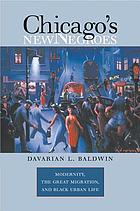 Chicago's New Negroes: Modernity, The Great Migration, and Black Urban Life
by
As early-twentieth-century Chicago swelled with an influx of at least 250,000 new black urban migrants, the city became a center of consumer capitalism, flourishing with professional sports, beauty shops, film production companies, recording studios, and other black cultural and communal institutions. Davarian Baldwin argues that this mass consumer marketplace generated a vibrant intellectual life and planted seeds of political dissent against the dehumanizing effects of white capitalism. Pushing the traditional boundaries of the Harlem Renaissance to new frontiers, Baldwin identifies a fresh model of urban culture rich with politics, ingenuity, and entrepreneurship.
Call Number: MAC Stacks - Level 4 F548.9.N4 B35 2007Publication Date: 2007
Chicago's New Negroes: Modernity, The Great Migration, and Black Urban Life
by
As early-twentieth-century Chicago swelled with an influx of at least 250,000 new black urban migrants, the city became a center of consumer capitalism, flourishing with professional sports, beauty shops, film production companies, recording studios, and other black cultural and communal institutions. Davarian Baldwin argues that this mass consumer marketplace generated a vibrant intellectual life and planted seeds of political dissent against the dehumanizing effects of white capitalism. Pushing the traditional boundaries of the Harlem Renaissance to new frontiers, Baldwin identifies a fresh model of urban culture rich with politics, ingenuity, and entrepreneurship.
Call Number: MAC Stacks - Level 4 F548.9.N4 B35 2007Publication Date: 2007 -
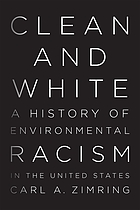 Clean and White: A History of Environmental Racism in the United States
by
From the age of Thomas Jefferson to the Memphis Public Workers strike of 1968 through the present day, ideas about race-- whites are "clean" and non-whites are "dirty"-- have shaped where people have lived, where people have worked, and how American society's wastes have been managed. Zimring draws on historical evidence from statesmen, scholars, sanitarians, novelists, activists, advertisements, and the United States Census of Population to reveal changing constructions of environmental racism, focusing on constructions of race and hygiene. The bigoted idea that non-whites are "dirty" remains deeply ingrained in the national psyche, continuing to shape social and environmental inequalities.
Call Number: MAC Stacks - Level 4 GE230 .Z56 2017Publication Date: 2017
Clean and White: A History of Environmental Racism in the United States
by
From the age of Thomas Jefferson to the Memphis Public Workers strike of 1968 through the present day, ideas about race-- whites are "clean" and non-whites are "dirty"-- have shaped where people have lived, where people have worked, and how American society's wastes have been managed. Zimring draws on historical evidence from statesmen, scholars, sanitarians, novelists, activists, advertisements, and the United States Census of Population to reveal changing constructions of environmental racism, focusing on constructions of race and hygiene. The bigoted idea that non-whites are "dirty" remains deeply ingrained in the national psyche, continuing to shape social and environmental inequalities.
Call Number: MAC Stacks - Level 4 GE230 .Z56 2017Publication Date: 2017 -
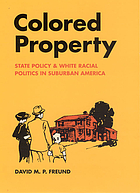 Colored Property: State Policy and White Racial Politics in Suburban America
by
Northern whites in the post-World War II era began to support the principle of civil rights, so why did many of them continue to oppose racial integration in their communities? Challenging conventional wisdom about the growth, prosperity, and racial exclusivity of American suburbs, David M.P. Freund argues that previous attempts to answer this question have overlooked a change in the racial thinking of whites and the role of suburban politics in effecting this change. In Colored Property, he shows how federal intervention spurred a dramatic shift in the language and logic of residential exclu.
Call Number: MAC Stacks - Level 4 E184.A1 F738 2007Publication Date: 2007
Colored Property: State Policy and White Racial Politics in Suburban America
by
Northern whites in the post-World War II era began to support the principle of civil rights, so why did many of them continue to oppose racial integration in their communities? Challenging conventional wisdom about the growth, prosperity, and racial exclusivity of American suburbs, David M.P. Freund argues that previous attempts to answer this question have overlooked a change in the racial thinking of whites and the role of suburban politics in effecting this change. In Colored Property, he shows how federal intervention spurred a dramatic shift in the language and logic of residential exclu.
Call Number: MAC Stacks - Level 4 E184.A1 F738 2007Publication Date: 2007 -
 A Consumers' Republic
by
A social and political history describes how mass consumption and the pursuit of prosperity transformed American life during the second half of the twentieth century.
Call Number: MAC Stacks - Level 4 HC110.C6 C537 2003Publication Date: 2003
A Consumers' Republic
by
A social and political history describes how mass consumption and the pursuit of prosperity transformed American life during the second half of the twentieth century.
Call Number: MAC Stacks - Level 4 HC110.C6 C537 2003Publication Date: 2003 -
 Downtown America
by
Downtown America was once the vibrant urban center romanticized in the Petula Clark song - a place where the lights were brighter, where people went to spend their money and forget their worries. But in the second half of the twentieth century, "downtown" became a shadow of its former self, succumbing to economic and commercial decline. And the death of Main Streets across the country came to be seen as sadly inexorable, like the passing of an aged loved one." "Downtown America cuts beneath this archetypal story of downtown's rise and fall and offers a new story of urban development in the United States. Moving beyond the conventional narratives, Alison Isenberg shows that the downtown's trajectory was not dictated by inevitable free market forces or natural life-and-death cycles. Instead, it was the product of human actors - the contested creation of retailers, developers, government leaders, architects, and planners, as well as political activists, consumers, civic clubs, real estate appraisers, and even postcard artists. Throughout the twentieth century, conflicts over downtown's mundane conditions - what it should look like and who should walk its streets - pointed to fundamental disagreements over American values." "Isenberg reveals how the innovative efforts of these participants infused Main Street with its resonant symbolism, while still accounting for pervasive uncertainty and fears of decline. Readers of this work will find anything but a story of inevitability. Even some of the downtown's darkest moments - the Great Depression's collapse in land values, the rioting and looting of the 1960s, or abandonment and vacancy during the 1970s - illuminate how core cultural values have animated and intertwined with economic investment to reinvent the physical form and social experiences of urban commerce. Downtown America - its empty stores, revitalized marketplaces, and romanticized past - will never look quite the same again." "A book that does away with our most cliched approaches to urban studies, Downtown America will appeal to readers interested in the history of the United States and the mythology surrounding its most cherished institutions
Call Number: MAC Stacks - Level 4 HT123 .I74 2004Publication Date: 2005
Downtown America
by
Downtown America was once the vibrant urban center romanticized in the Petula Clark song - a place where the lights were brighter, where people went to spend their money and forget their worries. But in the second half of the twentieth century, "downtown" became a shadow of its former self, succumbing to economic and commercial decline. And the death of Main Streets across the country came to be seen as sadly inexorable, like the passing of an aged loved one." "Downtown America cuts beneath this archetypal story of downtown's rise and fall and offers a new story of urban development in the United States. Moving beyond the conventional narratives, Alison Isenberg shows that the downtown's trajectory was not dictated by inevitable free market forces or natural life-and-death cycles. Instead, it was the product of human actors - the contested creation of retailers, developers, government leaders, architects, and planners, as well as political activists, consumers, civic clubs, real estate appraisers, and even postcard artists. Throughout the twentieth century, conflicts over downtown's mundane conditions - what it should look like and who should walk its streets - pointed to fundamental disagreements over American values." "Isenberg reveals how the innovative efforts of these participants infused Main Street with its resonant symbolism, while still accounting for pervasive uncertainty and fears of decline. Readers of this work will find anything but a story of inevitability. Even some of the downtown's darkest moments - the Great Depression's collapse in land values, the rioting and looting of the 1960s, or abandonment and vacancy during the 1970s - illuminate how core cultural values have animated and intertwined with economic investment to reinvent the physical form and social experiences of urban commerce. Downtown America - its empty stores, revitalized marketplaces, and romanticized past - will never look quite the same again." "A book that does away with our most cliched approaches to urban studies, Downtown America will appeal to readers interested in the history of the United States and the mythology surrounding its most cherished institutions
Call Number: MAC Stacks - Level 4 HT123 .I74 2004Publication Date: 2005 -
 From #BlackLivesMatter to Black Liberation
by
Call Number: E185.86 .T367 2016Publication Date: 2016
From #BlackLivesMatter to Black Liberation
by
Call Number: E185.86 .T367 2016Publication Date: 2016 -
 Making the Second Ghetto
by
Arnold Hirsch argues that in the postdepression years Chicago was a "pioneer in developing concepts and devices" for housing segregation and that the legal framework for the national urban renewal effort was forged in the heat generated by the racial struggles on Chicago's South Side. In chronicling the strategies used by ethnic, political, and business interests threatened by the great migration of southern blacks in the 1940s, Hirsch reveals how the violent reaction of an emergent "white" population combined with public policy to segregate the city.
Call Number: MAC Stacks - Level 4 HD7288.72.U52 H57 1998Publication Date: 1998
Making the Second Ghetto
by
Arnold Hirsch argues that in the postdepression years Chicago was a "pioneer in developing concepts and devices" for housing segregation and that the legal framework for the national urban renewal effort was forged in the heat generated by the racial struggles on Chicago's South Side. In chronicling the strategies used by ethnic, political, and business interests threatened by the great migration of southern blacks in the 1940s, Hirsch reveals how the violent reaction of an emergent "white" population combined with public policy to segregate the city.
Call Number: MAC Stacks - Level 4 HD7288.72.U52 H57 1998Publication Date: 1998 -
 The Origins of the Urban Crisis
by
Once America's "arsenal of democracy," Detroit has become the symbol of the American urban crisis. In this reappraisal of America's dilemma of racial and economic inequality, Thomas Sugrue asks why Detroit and other industrial cities have become the sites of persistent racialized poverty. He challenges the conventional wisdom that urban decline is the product of the social programs and racial fissures of the 1960s. Weaving together the history of workplaces, unions, civil rights groups, political organizations, and real estate agencies, Sugrue finds the roots of today's urban poverty in a hidden history of racial violence, discrimination, and deindustrialization that reshaped the American urban landscape after World War II.
Call Number: MAC Stacks - Level 4 F574.D49 N4835 2005Publication Date: 2005
The Origins of the Urban Crisis
by
Once America's "arsenal of democracy," Detroit has become the symbol of the American urban crisis. In this reappraisal of America's dilemma of racial and economic inequality, Thomas Sugrue asks why Detroit and other industrial cities have become the sites of persistent racialized poverty. He challenges the conventional wisdom that urban decline is the product of the social programs and racial fissures of the 1960s. Weaving together the history of workplaces, unions, civil rights groups, political organizations, and real estate agencies, Sugrue finds the roots of today's urban poverty in a hidden history of racial violence, discrimination, and deindustrialization that reshaped the American urban landscape after World War II.
Call Number: MAC Stacks - Level 4 F574.D49 N4835 2005Publication Date: 2005 -
 The Search for Order, 1877-1920
by
Wiebe sees the Progressive era of Theordore Roosevelt and Woodrow Wilson as a search for organizing principles around which a viable social order could be constructed in a new, largely impersonal world.
Call Number: MAC Stacks - Level 4 E661 .W58Publication Date: 1966
The Search for Order, 1877-1920
by
Wiebe sees the Progressive era of Theordore Roosevelt and Woodrow Wilson as a search for organizing principles around which a viable social order could be constructed in a new, largely impersonal world.
Call Number: MAC Stacks - Level 4 E661 .W58Publication Date: 1966 -
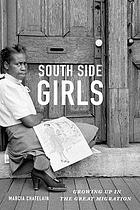 South Side Girls: Growing Up in the Great Migration
by
"In South Side Girls Marcia Chatelain recasts Chicago's Great Migration through the lens of black girls. Focusing on the years between 1910 and 1940, when Chicago's black population quintupled, Chatelain describes how Chicago's black social scientists, urban reformers, journalists and activists formulated a vulnerable image of urban black girlhood that needed protecting. She argues that the construction and meaning of black girlhood shifted in response to major economic, social, and cultural changes and crises, and that it reflected parents' and community leaders' anxieties about urbanization and its meaning for racial progress. Girls shouldered much of the burden of black aspiration, as adults often scrutinized their choices and behavior, and their well-being symbolized the community's moral health.
Call Number: MAC Stacks - Level 4 F548.9.N4 C438 2015Publication Date: 2015
South Side Girls: Growing Up in the Great Migration
by
"In South Side Girls Marcia Chatelain recasts Chicago's Great Migration through the lens of black girls. Focusing on the years between 1910 and 1940, when Chicago's black population quintupled, Chatelain describes how Chicago's black social scientists, urban reformers, journalists and activists formulated a vulnerable image of urban black girlhood that needed protecting. She argues that the construction and meaning of black girlhood shifted in response to major economic, social, and cultural changes and crises, and that it reflected parents' and community leaders' anxieties about urbanization and its meaning for racial progress. Girls shouldered much of the burden of black aspiration, as adults often scrutinized their choices and behavior, and their well-being symbolized the community's moral health.
Call Number: MAC Stacks - Level 4 F548.9.N4 C438 2015Publication Date: 2015 -
 Standing at Armageddon
by
tanding at Armageddon is a comprehensive and lively historical account of America's shift from a rural and agrarian society to an urban and industrial society. Nell Irvin Painter will be featured in the PBS multipart series The Progressive Era with Bill Moyers, which coincides with the release of the updated edition of this acclaimed work
Call Number: MAC Stacks - Level 4 E661 .P33 1987Publication Date: 2008
Standing at Armageddon
by
tanding at Armageddon is a comprehensive and lively historical account of America's shift from a rural and agrarian society to an urban and industrial society. Nell Irvin Painter will be featured in the PBS multipart series The Progressive Era with Bill Moyers, which coincides with the release of the updated edition of this acclaimed work
Call Number: MAC Stacks - Level 4 E661 .P33 1987Publication Date: 2008 -
 Suburban Erasure
by
For generations, historians believed that the study of the African-American experience centered on the questions about the processes and consequences of enslavement. Even after this phase passed, the modern Civil Rights Movement took center stage and filled hundreds of pages, creating a new framework for understanding both the history of the United States and of the world. Suburban Erasure by Walter David Greason contributes to the most recent developments in historical writing by recovering dozens of previously undiscovered works about the African-American experience in New Jersey. More importantly, his interpretation of these documents complicates the traditional understandings about the Great Migration, civil rights activism, and the transformation of the United States as a global, economic superpower.
Publication Date: 2012
Suburban Erasure
by
For generations, historians believed that the study of the African-American experience centered on the questions about the processes and consequences of enslavement. Even after this phase passed, the modern Civil Rights Movement took center stage and filled hundreds of pages, creating a new framework for understanding both the history of the United States and of the world. Suburban Erasure by Walter David Greason contributes to the most recent developments in historical writing by recovering dozens of previously undiscovered works about the African-American experience in New Jersey. More importantly, his interpretation of these documents complicates the traditional understandings about the Great Migration, civil rights activism, and the transformation of the United States as a global, economic superpower.
Publication Date: 2012 -
 To 'Joy My Freedom
by
Tera Hunter follows African-American working women from their newfound optimism and hope at the end of the Civil War to their struggles as free domestic laborers in the homes of their former master. We witness their drive as they build neighborhoods and networks and their energy as they enjoy leisure hours in dance halls and clubs. We learn of their militance and the way they resisted efforts to keep them economically depressed and medically victimized. Finally, we see the despair and defeat provoked by Jim Crow laws and segregation and how they spurred large numbers of black laboring women to migrate north.
Call Number: MAC Stacks - Level 4 HD6057.5.U52 G45 1997Publication Date: 1997
To 'Joy My Freedom
by
Tera Hunter follows African-American working women from their newfound optimism and hope at the end of the Civil War to their struggles as free domestic laborers in the homes of their former master. We witness their drive as they build neighborhoods and networks and their energy as they enjoy leisure hours in dance halls and clubs. We learn of their militance and the way they resisted efforts to keep them economically depressed and medically victimized. Finally, we see the despair and defeat provoked by Jim Crow laws and segregation and how they spurred large numbers of black laboring women to migrate north.
Call Number: MAC Stacks - Level 4 HD6057.5.U52 G45 1997Publication Date: 1997 -
 The White Man's Burden
by
Examines the development of racist practices, policies, and attitudes during the years of colonization and revolution.
Call Number: MAC Stacks - Level 4 E446 .J67 1974Publication Date: 1974
The White Man's Burden
by
Examines the development of racist practices, policies, and attitudes during the years of colonization and revolution.
Call Number: MAC Stacks - Level 4 E446 .J67 1974Publication Date: 1974


Articles - Industrial Segregation
-
"The Real Wealth of Nations; Free Exchange."
